
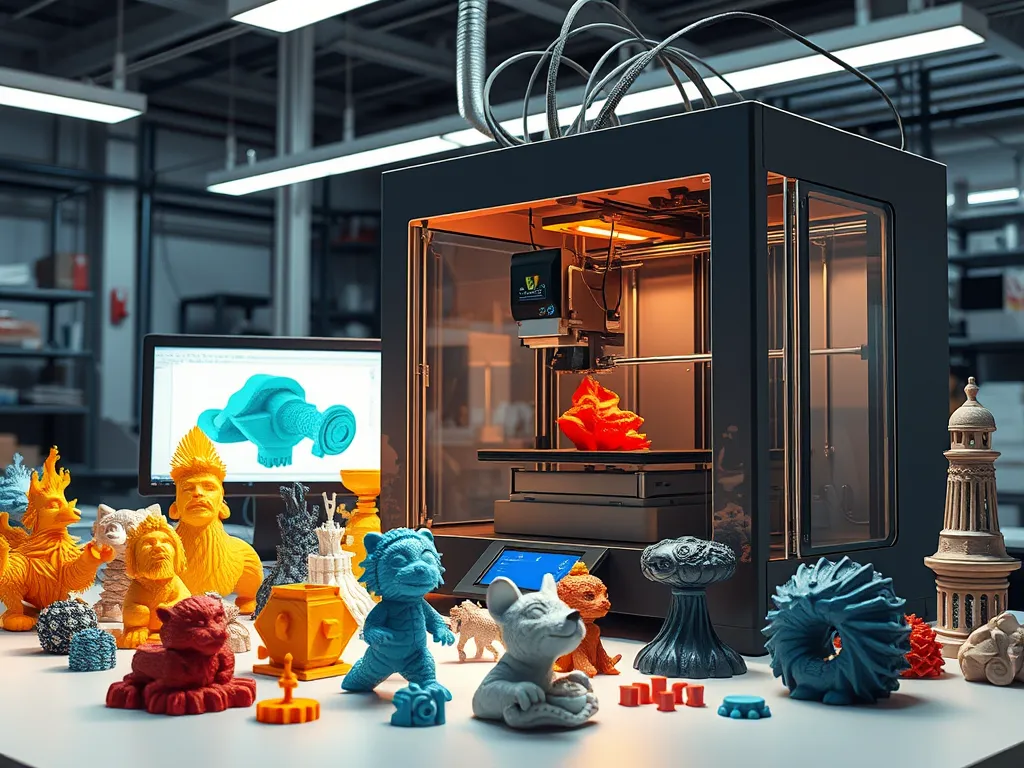
3D printing, also called additive manufacturing, builds a part layer by layer straight from a digital model. That simple idea has changed how products are developed. A prototype that once needed a machinist, a mould or weeks of waiting can now be on your desk within days of finishing the CAD model, and the next version shortly after.
This article covers why 3D printing has become the default way to prototype, where it is used, where it falls short, and when to move on to other manufacturing methods.
How rapid prototyping with 3D printing works
- Design the part in CAD software.
- Export it as an STL, 3MF, OBJ or STEP file.
- Print it. Slicing software turns the model into layers and toolpaths, and the printer builds it.
- Test it. Hold it, fit it, load it, show it to users or clients.
- Change the design and print again.
The value is in how quickly you can go round that loop. Each revision costs a print, not a new tool.
The benefits
Speed
A prototype can often be printed in hours, depending on its size and complexity. Designers and engineers can test an idea, find the problem and try a fix within days rather than weeks. Over a whole project, those short loops add up to a faster time to market.
Low cost without tooling
Traditional methods such as injection moulding need a mould before the first part exists, and CNC machining needs set-up time and skilled labour for each part. 3D printing needs neither, which makes one-off and low-volume parts affordable. It also uses only the material the part needs, rather than cutting a part out of a larger block.
Design freedom
Printing handles shapes that are hard or impossible to machine or mould: internal channels, lattices, organic curves and parts combined into one. A prototype can be printed exactly as designed, rather than simplified to suit the process.
Better communication
A physical model settles questions a screen cannot. Stakeholders can hold it, see the real size, feel the weight and spot problems early. Feedback on a prototype is faster and more specific than feedback on a rendering.
Customisation
Because each print is made directly from its own file, every copy can be different at no extra set-up cost. That makes it practical to test several variations side by side, or to make parts tailored to one person or one machine.
Where 3D printed prototypes are used
- Consumer products: housings, enclosures, handles and mock-ups for form, fit and user testing.
- Automotive: brackets, clips, ducting and interior parts to test fit and ergonomics before tooling.
- Medical: anatomical models for surgical planning, and custom devices such as dental aligner moulds and hearing aid shells.
- Architecture and construction: scale models for design reviews and client presentations.
- Education and research: turning concepts into objects students and researchers can test.
- Manufacturing: jigs, fixtures and tooling that are prototypes and production aids at the same time.
The limits to plan around
3D printing is not a perfect stand-in for the final product, and a good prototype plan accounts for that.
- Layer strength. FDM parts are weaker between layers than along them, so orientation affects strength. Our guide to designing for FDM covers this.
- Material differences. A printed part in PLA does not behave exactly like the moulded production part in another plastic. Test for what the prototype can tell you, and know what it cannot.
- Surface finish. Layer lines show on FDM parts. Resin printing gives a much smoother surface for small parts, and sanding and painting can close the gap for presentation models.
- Volume. Printing is cheapest per part at low volumes. As quantities rise, moulding usually becomes cheaper per part.
Deciding early whether you need a visual model or a working part saves a lot of iteration. Our article on functional prototypes vs visual models explains the difference.
From prototype to production
Once the design is settled, the question becomes how to make it in quantity. For short runs, 3D printing may still be the right answer. For larger runs, injection moulding usually wins on cost per part once the mould is paid for. Our article on when injection moulding beats 3D printing shows how to find the break-even point.
The future of prototyping
Printable materials keep widening, from engineering plastics to metals and ceramics, and printers keep getting larger and more affordable. The loop from idea to part in hand is only getting shorter.
Get your prototype printed
If you have a CAD model ready, our prototype 3D printing service gives you a price in seconds: upload the file, choose the material, colour, infill and quantity, and we print it and ship it anywhere in Australia.