The field of architecture has always been at the forefront of innovation and design. Over the years, architects have constantly sought new ways to bring their ideas to life, often relying on traditional model-making techniques to visualize and communicate their concepts. However, with the advent of 3D printing technology, the world of architectural model-making has been completely transformed, making 3dprinting-architectural-models a reality.
In the past, architects would spend countless hours meticulously crafting physical models by hand. These models were often made from materials such as wood, foam, or cardboard, requiring a significant amount of time and skill to construct. While these models were able to provide a tangible representation of the design, they were limited in terms of precision and the ability to accurately communicate the intricate details of the project.
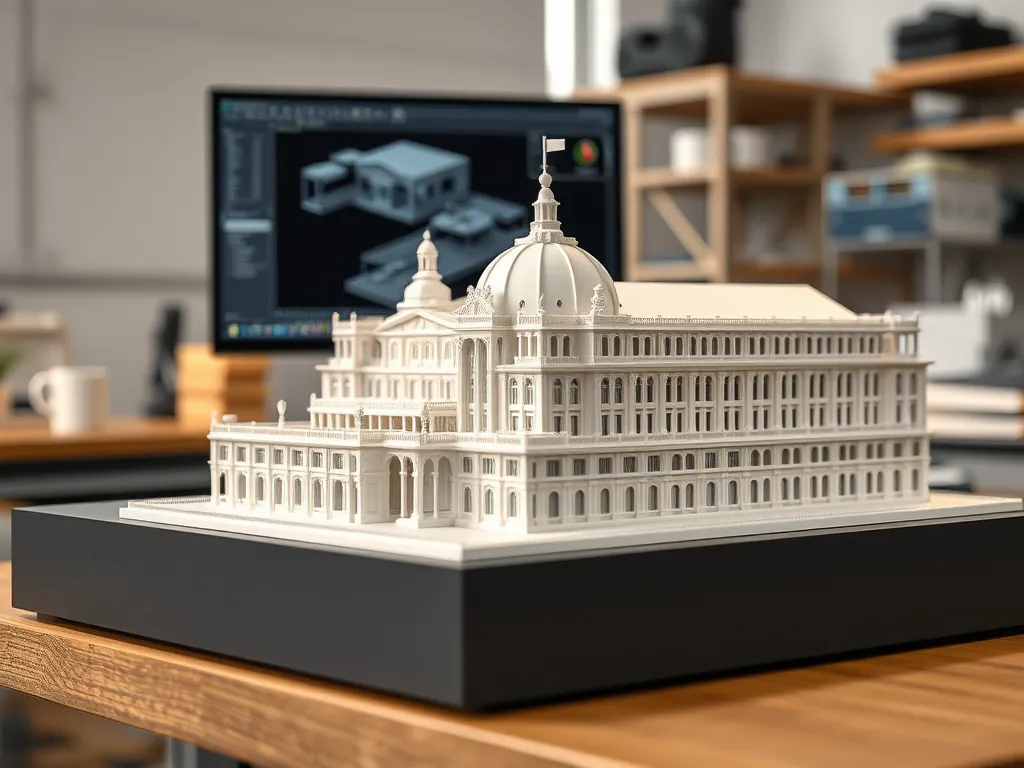
Enter 3D printing – a game-changing technology that has revolutionized the way architects approach model-making. With 3D printing, architects can now create highly detailed, accurate, and realistic models in a fraction of the time it took using traditional methods. Using computer-aided design (CAD) software, architects can create virtual 3D models of their designs, which can then be printed layer by layer using a 3D printer.
One of the most significant advantages of 3D printing architectural models is the level of detail that can be achieved. With traditional model-making techniques, it was often challenging to accurately represent intricate elements such as complex facades or interior spaces. 3D printing allows architects to not only create models that accurately represent their designs but also convey the intricate details that make each project unique.
Moreover, 3D printing allows for a high level of customization and flexibility. Architects can easily modify and revise their designs on the computer, and the updated model can be printed in no time. This flexibility enables architects to explore various design options and iterate on their concepts until they achieve the desired outcome. It also facilitates collaboration among project stakeholders as 3D printed models can be easily shared and reviewed, providing a clearer understanding of the proposed design.
Another significant advantage of 3D printed architectural models is the cost-effectiveness. While traditional models often require expensive materials and skilled craftsmanship, 3D printing can significantly reduce the cost associated with model-making. Architects can now create multiple iterations of their models at a fraction of the cost, allowing for greater experimentation and exploration during the design process.
Furthermore, 3D printing has the potential to revolutionize the way we construct buildings in the future. With advancements in materials and technology, it may become possible to 3D print entire architectural structures. This concept, known as additive manufacturing in construction, has already gained traction with several projects worldwide. The ability to 3D print buildings could potentially revolutionize the construction industry, offering faster, more sustainable, and cost-effective building solutions.
Despite its many advantages, 3D printing architectural models does come with a few limitations. One of the main challenges is the size of the models that can be printed. Most 3D printers have size limitations, meaning that larger-scale models may need to be printed in multiple sections and assembled manually. However, as technology continues to evolve, we can expect to see improvements in this area, enabling architects to print larger and more complex models.
In conclusion, 3D printing has undeniably revolutionized the way architects approach model-making. This technology offers a level of detail, precision, and flexibility that was previously unattainable with traditional methods. Architects can now create highly accurate and realistic models, explore various design options, and communicate their ideas more effectively. As technology continues to advance, the possibilities for 3D printing in architecture are limitless, paving the way for a more innovative and sustainable future in the built environment.