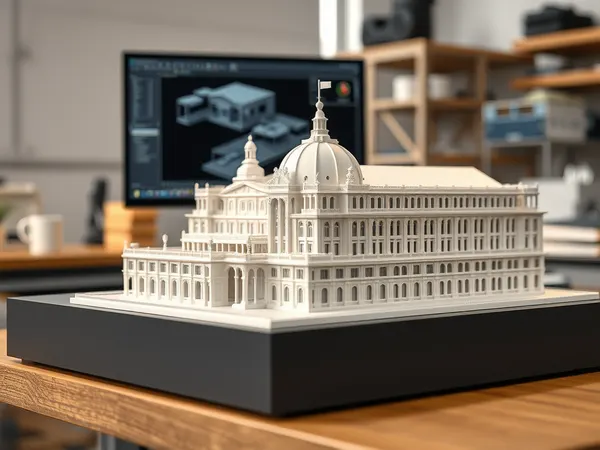
The trade show and marketing model is one of the most underused applications of 3D printing for Australian businesses. Many businesses still rely on stock product photography, a brochure, and a sample if they are lucky, when a custom physical model in their hand would close significantly more conversations. The cost has come down to the point where this is a sensible marketing line item, not an exotic one.
Why physical models still convert
Sales conversations work better when there is something to point at. A potential customer can read the spec sheet, look at the render, and watch the video, but the moment the salesperson hands them a physical model the conversation changes. The customer engages with the geometry, asks better questions, and remembers the conversation in a way that screen-based marketing struggles to match.
This is particularly true for products that are large, expensive, or under development. A scale model of a piece of plant machinery, a building, a custom installation, or a not-yet-released product, in the customer’s hand, does what no marketing collateral can.
Common formats that work
Scale models of full systems. A 1:10 or 1:20 model of a piece of industrial equipment, painted and finished, makes a trade show stand or showroom dramatically more engaging.
Cutaway models. A model showing the internals of a product, with the casing partially removed, helps customers understand the value proposition that the finished product hides.
Pre-production prototypes. A look-and-feel model of a product still in development. These let the marketing team start the conversation with customers months before the production line is ready.
Custom branded giveaways. Personalised models distributed at trade shows, with the customer’s logo or name integrated. Significantly more memorable than a USB stick or a stress ball.
Material and finish for marketing models
Marketing models live or die by their finish. A great geometry undermined by visible layer lines is worse than no model at all. The investment in proper post-processing (sanding, priming, painting, clear-coating) is the difference between a model that looks finished and one that looks like a prototype. For high-volume needs, resin or finely-detailed FDM with full finishing typically delivers the best result.
Colour matters too. A model painted in the actual brand colours, with metallic or matte finishes that match the production product, reads as on-brand. A bare-plastic print, however accurate, reads as a prototype.
Integration with marketing workflows
The physical model is not a standalone artefact. It works best when it sits alongside the rest of the marketing system: the website, the brochure, the email follow-up, the CRM record of the conversation. Businesses doing this well capture the trade show conversation digitally on the day, follow up automatically within 24 hours, and reference the specific model the prospect saw in the follow-up. Marketing teams that have already invested in AI-driven marketing and sales workflows can plug the physical-model interaction into the same pipeline that handles digital enquiries.
Cost and lead time
A typical marketing-grade scale model, 200 to 400mm in size, fully finished and painted, runs in the few-hundred-dollar range and 1 to 3 weeks lead time. For high-detail or large models, both go up. For runs of 5 to 50 identical models (a trade show giveaway, for example), per-unit cost drops significantly. Planning at least 4 weeks ahead of a major event is the safe margin.
Reuse and refresh
A well-built marketing model has a useful life of years, not weeks. The same model can travel between trade shows, sit in the showroom between events, appear in photography for the website, and be loaned to important prospects for in-house meetings. Treat the model as a long-lived asset and the cost amortises across many interactions.
The bottom line
Custom physical models are one of the more under-rated marketing investments available to Australian businesses in 2026. The cost is reasonable, the production timeline is manageable, the conversation impact is real, and the assets have a long useful life. For any business selling something that benefits from being touched, picked up or examined, a properly briefed and finished 3D printed marketing model deserves a place in the line item budget.